Sound insulation batts for wall and ceiling cavities

ISO NOISE is a sound insulation batt for the cavity of lightweight walls, double-leaf masonry walls and ceilings. Two variants with the same size and thickness give the same sound-insulation benefit inside a wall — choose by the environment of the job.

In short

Size
60 × 120 cm, 50 mm thick, 6 sheets per pack (4.32 m²)
Price
Standard (glass fiber) 180 THB/sheet · Premium (polyester) 250 THB/sheet, excluding delivery
Result
Test result cited in the ISO NOISE article: a lightweight wall with an insulated cavity blocks at least 7–10 dB more than one with an empty cavity, mainly at mid and high frequencies. The actual figure depends on the wall system. See the test and its conditions (Thai)
Field result
A meeting-room partition insulated with ISO NOISE measured NNIC 47 after installation, against a target of more than 40. See the wall and the measurement (Thai)
Does not work when
it is glued to an existing wall with no covering board, the wall or door leaks, or the noise is impact or structure-borne.

Ask on LINE Call 062-195-1909

Glass fiber

ISO NOISE Standard

Glass-fiber batt for the cavity of lightweight and double-leaf walls

Size
60 × 120 cm
Thickness
50 mm
Reference price
180 THB / sheet
View product

Polyester fiber

ISO NOISE Premium

Polyester batt that tolerates moisture — for exterior walls and noise barriers

Size
60 × 120 cm
Thickness
50 mm
Reference price
250 THB / sheet
View product

Compare variants

StandardPremium
MaterialGlass fiberPolyester fiber
Size60 × 120 cm60 × 120 cm
Thickness50 mm50 mm
EnvironmentInteriorInterior and exterior; tolerates humidity
Material NRC (catalogue)0.850.76
Reference price180 THB / sheet250 THB / sheet
Price per pack (6 sheets)1,080 THB1,500 THB
Price per m² (from the sheet price)about 250 THBabout 347 THB
Best forInterior lightweight walls and ceilings: bedrooms, meeting rooms, rehearsal roomsExterior sound-insulating walls, noise barriers and humid locations
LimitationsInterior useHigher price per sheet than Standard

Both must sit inside a wall or ceiling cavity closed with a solid layer such as gypsum, fibre-cement board or brick. Reference price. Please confirm current pricing and delivery with our team.

The batt is one part of a wall system

How much sound a room keeps in or out depends on the complete wall or ceiling system, not on the batt alone. NRC in the table is the absorption of the material; the sound insulation of a wall is expressed by the STC of the system.

See STC values of common wall systems (Thai)

NRC vs STC

NRC (Noise Reduction Coefficient) is the sound absorption of a material, from 0 to 1. It does not say how well the material stops sound passing through.

STC (Sound Transmission Class) is the sound insulation of a complete wall or ceiling system. The higher it is, the less sound passes. It depends on the boards, frame, cavity, insulation and leaks together.

An ISO NOISE batt therefore has no STC of its own: it is one part of a wall. It absorbs sound in the cavity between the boards, which raises the STC of the whole system.

Absorption panels vs sound insulation (Thai)

Choose by the noise problem

Footsteps, impacts or machines that vibrate through floors and walls must also be treated at the source; adding insulation to a wall alone helps little. Send the details to the engineer before ordering.

Estimate sheets and price

Enter the size of the wall or ceiling to be insulated. Sheets are counted from the 60 × 120 cm sheet size (0.72 m²).

Area
– m²
Sheets
– sheets equals – packs (6 sheets each)
Estimated product price
– THB

This is an estimate. It excludes cutting waste and delivery; the engineer confirms quantity and price in the quotation.

Send this estimate on LINE

Installation

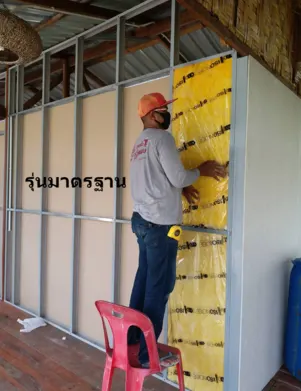
  1. Fit the batts, still in their clear PE bags, to fill the whole area of the lightweight wall or double-leaf masonry wall. No adhesive is needed.
  2. Where the wall does not match full sheets, cut the batt to fill the remaining area. No adhesive or tape is required.
  3. Close the cavity with a solid layer such as gypsum board, fibre-cement board or brick so the wall system can block sound.

Recommended wall and ceiling systems (Thai)

Frequently asked questions

How many decibels does ISO NOISE block?
Sound insulation depends on the whole wall or ceiling system, not on the batt alone. System performance is expressed as STC. Compared with a lightweight wall with an empty cavity, adding the batt raises the wall’s sound insulation by about 7–10 dB (perceived as roughly half as loud).
Can I simply glue the batt onto an existing wall?
No. The batt works when it is the core inside the cavity of a lightweight wall or a double-leaf masonry wall. Glued onto an existing wall without a covering layer, it does not improve sound insulation.
Should the plastic bag be removed before installation?
No. The batt is designed to go into the cavity in its bag. The bag keeps fibres contained and protects against moisture.
Is performance better with or without the bag?
Research found an unbagged batt performs only 1–2 dB better, which is very small. Keeping the bag contains fibres, protects against moisture and makes installation easier, so installing in the bag is recommended.
What do I do with the bag after cutting a batt?
You can seal the cut end with clear tape, or install it untaped. Very small off-cuts can be unbagged and packed in. The aim is to fill the whole wall area.
How does ISO NOISE compare with SCG Cylence ZoundBlock?
Equivalent.
The batt is 50 mm thick. Can I get a thicker one?
The standard thickness is 50 mm. For a 3-inch frame, 50 mm is sufficient. For a 4-inch frame, use two 50 mm layers.
Is the result guaranteed?
When a wall with the batt still fails, it is usually because the wall system was not built as the engineer recommended, so its STC is too low. Other causes are leaks in the wall, or noise that is impact or structure-borne vibration rather than airborne sound.
How do I order?
Order directly from the engineer. Tell us the wall area; the engineer calculates the number of sheets and quotes product and delivery. Goods ship once payment is received.
How does delivery outside Bangkok work, and what does it cost?
Order directly from the engineer as well. Goods are handed to a private freight company and freight is paid on delivery. Upcountry freight is typically about 80 THB per pack (6 sheets) for depot pick-up, or 100–200 THB for home delivery. In Bangkok, delivery is by Lalamove at actual cost. Freight figures are estimates and vary by carrier.

Talk to an acoustic engineer directly

Tell us the wall or ceiling area you need to treat. The engineer will calculate the number of sheets, recommend a suitable wall system and quote the goods with delivery anywhere in Thailand.
Ask on LINE Call